
Islamic Finance
How to Calculate Zakat in Pakistan — A Complete Step-by-Step Guide
By Marwat • Published 16 November 2026 • Updated 16 November 2026 • 17 min read • 3,230 words
How to calculate Zakat in Pakistan step by step: nisab, gold and silver rates, zakatable wealth, debts, worked PKR examples and the free Zakat Calculator.
Try the free tool →
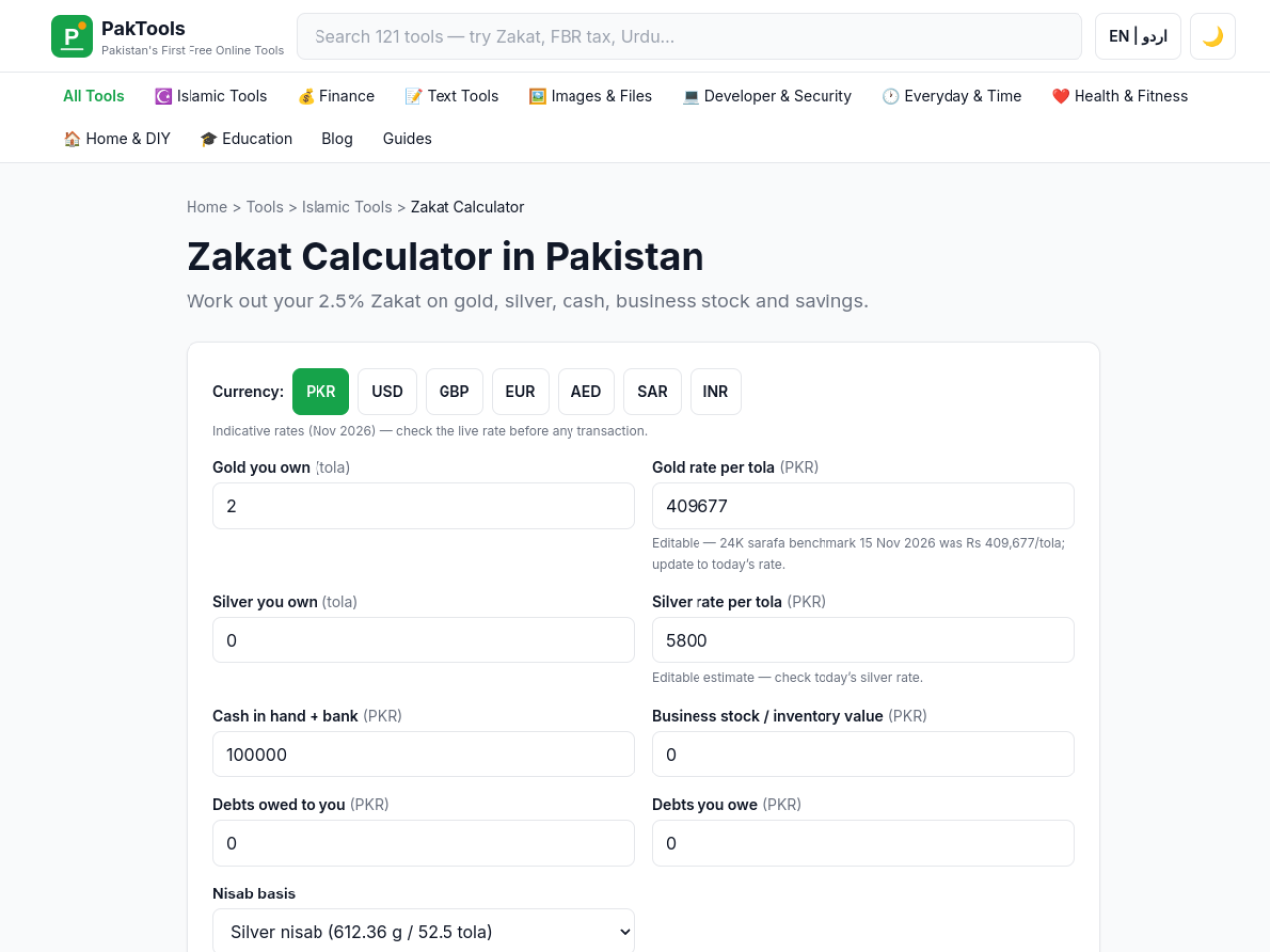
Zakat Calculator in PakistanWork out your 2.5% Zakat on gold, silver, cash, business stock and savings.

Every year, millions of Muslims in Pakistan ask the same question: how much Zakat do I actually owe this year? The answer is simpler than many people think, but it is easy to get wrong if you mix up the nisab threshold, forget a bank account, use an outdated gold rate, or count things that are not zakatable. This guide walks you through the whole calculation step by step, in plain English, with Pakistani rupees, local gold rates, and examples that match real life in Lahore, Karachi, Islamabad, Faisalabad, Rawalpindi, and smaller cities across the country. By the end you will be able to calculate your own Zakat with confidence, check the result with our free [[Zakat Calculator|/tools/islamic/zakat-calculator]], and explain the working to your family.
Zakat is one of the five pillars of Islam. It is not charity in the general sense, and it is not the same as sadaqah. It is a fixed obligation on wealth that has been held for a full lunar year, once that wealth reaches a minimum level called nisab. The rate is 2.5 percent of your zakatable wealth. If your wealth is below nisab, you do not pay Zakat. If it is above nisab, you pay 2.5 percent on the total zakatable amount, not only on the amount above nisab. That distinction matters, and it is one of the most common mistakes people make, so this guide comes back to it with worked examples later on.
This guide is educational only, not financial advice, and for religious questions you should verify with your local scholar. Rules can differ slightly between schools of thought, especially on items such as jewellery worn daily, business stock, and agricultural produce. This guide explains the widely used position in Pakistan and flags the places where scholars differ, so you can ask an informed question rather than guessing. To make the maths easy, try our free Zakat Calculator after reading the guide: enter your cash, gold, silver, and other assets and it will apply the 2.5 percent rate for you.
What Is Zakat and Who Has to Pay It?
Zakat is an annual payment of 2.5 percent on certain kinds of wealth, paid by a Muslim who owns wealth above the nisab threshold for one full lunar year, known as a hawl. The recipients are defined in the Quran and include the poor, the needy, those in debt, and other eligible categories. The person paying Zakat does not choose the recipients freely from anyone they like; the money must go to people who qualify. In Pakistan, most people pay Zakat directly to relatives, neighbours, or trusted charities, while some also have Zakat deducted from bank savings accounts, which follows its own rules and timing.
Not every kind of wealth is zakatable. Your house that you live in, the car you drive every day, your clothes, your furniture, and the tools you use for your work are generally not counted, because they are for personal use rather than growing wealth. What is counted is cash in hand and in the bank, gold and silver whether in the form of jewellery, coins, or bars, business stock and trade goods, money owed to you that you expect to receive, and investments such as shares held for trading. If you run a shop in Saddar, a small online business from home, or a trading account, the stock and cash of that business are normally part of your Zakat calculation, while the shop building itself is not.
You also need to understand the hawl, the lunar year. Zakat becomes due when you have held wealth above nisab for one complete lunar year, which is about 354 days. Many people in Pakistan fix one date each year, often the 1st of Ramadan, and calculate everything on that date. That is a practical approach: pick a Zakat date, list everything you own on that date, subtract what you owe, and pay 2.5 percent. If your wealth falls below nisab during the year but rises above it again before your Zakat date, scholars differ on the details, so this is another point to verify with your local scholar if it applies to you.
What Is Nisab in Pakistan?
Nisab is the minimum amount of wealth above which Zakat becomes obligatory. It is defined by weight, not by rupees: 87.48 grams of gold, which is 7.5 tola, or 612.36 grams of silver, which is 52.5 tola. One tola equals 11.6638 grams, so 7.5 tola multiplied by 11.6638 gives 87.48 grams, and 52.5 tola gives 612.36 grams. Because gold and silver prices change every day, the rupee value of nisab also changes every day. You must use the rate on your Zakat date, not a rate from six months ago or a rate you remember from last Ramadan.
As a dated benchmark, the 24-karat gold rate in the Pakistani sarafa market on 15 November 2026 was Rs 409,677 per tola. Using that benchmark, the gold nisab works out to 7.5 multiplied by Rs 409,677, which is about Rs 3,072,578. That figure is only a benchmark for illustration, because gold rates change daily, and you should check the live rate on the day you calculate your Zakat. Silver nisab is much lower in rupees because silver is far cheaper per gram than gold, so many scholars advise using the silver nisab because it brings more people into paying Zakat and benefits more poor people. In Pakistan, the majority position used by many scholars is to use the silver nisab for cash and similar assets, but there is a difference of opinion, so verify with your local scholar which threshold your family follows.
In practice, this means the first question is not how much Zakat you owe, but whether you owe Zakat at all. Add up your zakatable wealth, subtract your immediate debts, and compare the result with nisab on that day. If the net figure is below nisab, no Zakat is due. If it is above nisab, Zakat is 2.5 percent of the whole net zakatable amount. Our [[Zakat Calculator|/tools/islamic/zakat-calculator]] lets you enter your gold weight in tola or grams, your silver, your cash, and your bank balances, and it converts them using the rate you enter, so you are not locked into an old rate from the internet.
What Counts as Zakatable Wealth?
Start your list with cash. That means the cash in your wallet and at home, the balance in every bank account including current accounts, savings accounts, and foreign currency accounts converted to rupees, money in digital wallets such as JazzCash and Easypaisa, and prize bonds. Prize bonds are cash-like holdings and are normally counted at their face value. Check every account, including a dormant account with a small balance, because all cash counts and a missed account is the most common reason people underpay Zakat.
Next comes gold and silver. Count all gold and silver jewellery, coins, and bars, whether worn daily or stored in a locker. The value depends on the weight and the purity: 24-karat gold is pure gold, while 22-karat jewellery is about 91.6 percent pure and 21-karat is about 87.5 percent pure, so you must convert to pure gold weight before valuing it. If you do not know the karat of inherited jewellery, ask a trusted jeweller to test it. Our [[Gold Price Calculator|/tools/finance/gold-price-calculator]] can value your gold by weight and purity at the rate you enter, which gives you the rupee figure to carry into your Zakat calculation.
Then add business wealth. If you run a business, count the trade stock at its current selling price, the cash in the till and in business bank accounts, and money owed to you by customers that you realistically expect to receive. Do not count the shop building, the delivery van used for the business, or the machinery, because those are tools of the trade rather than trade goods. For investments, shares held for trading are normally counted at their current market value, while shares held for long-term dividends are treated differently by different scholars, so ask about those separately. Finally, count money people owe you: a loan you gave to a relative, a committee payout due to you, or an unpaid invoice that will realistically be paid.
What Debts Can You Subtract?
Before you apply the 2.5 percent rate, subtract your immediate debts and liabilities. This includes money you owe to other people, a loan instalment that is due now, unpaid bills, and business debts that are payable. The logic is simple: Zakat is due on the wealth you actually own free and clear, not on money that is already promised to someone else. Write down every debt with its amount and its due date, so you can show the working to your family or your scholar.
Long-term debts are treated differently by different scholars, and this is where many people make an expensive mistake. Some scholars allow you to deduct only the instalment due within the year, while others allow the whole debt. If you have a large car loan or home loan, do not simply subtract the entire outstanding balance without asking a scholar, because that can wrongly reduce your Zakat to zero. For a simple personal calculation, subtract debts that are due and payable now, and ask about long-term loans separately before you finalise the figure.
A useful test is to ask yourself whether the debt must be paid from the wealth you are counting. If you owe a supplier Rs 300,000 this month and the money is sitting in your business account, that Rs 300,000 is not really yours to keep, so it comes off the total. If you owe Rs 2,000,000 on a house loan repayable over ten years, only the instalments falling due soon are normally deducted, because the rest of the loan is matched by the house itself, which is not zakatable. Keep the record of what you deducted and why, so next year you can follow the same rule consistently.
How to Calculate Zakat Step by Step
Step one is to fix your Zakat date and gather your numbers. Pick one date each year, for example the 1st of Ramadan, and use that date every year. On that date, write down the current gold and silver rates from your local sarafa market, then list every bank balance, every cash holding, every piece of gold and silver with its weight and karat, your business stock at selling price, and money owed to you. Use the [[Pakistani Date Format Converter|/tools/everyday/pakistani-date-format-converter]] to write the date clearly in long format, for example 15 November 2026, so there is no confusion between day and month when you keep your records.
Step two is to value the gold and silver at the current rate. Multiply the pure gold weight in tola by the current 24-karat rate per tola, and do the same for silver. Remember that one tola is 11.6638 grams, so if your jeweller gave you the weight in grams, divide by 11.6638 to get tola. For 22-karat jewellery, multiply the total weight by 22 divided by 24 to get the pure gold weight first. This is the step where an old rate or a wrong karat causes the biggest errors, so take your time and double-check the rate with a second source if you can.
Step three is to add everything up, subtract your immediate debts, and compare the net total with nisab. If the net total is below nisab, stop: no Zakat is due this year, but keep the record so you can check again next year. If the net total is at or above nisab, step four is to multiply the net total by 2.5 percent, which is the same as dividing by 40. That is the whole formula: Zakat equals 2.5 percent of net zakatable wealth. A quick check is to divide your net zakatable wealth by 40 and you have your Zakat amount.
Worked Examples in PKR
Consider Ayesha, a teacher in Faisalabad. On her Zakat date she has Rs 450,000 in her bank accounts, Rs 50,000 cash at home, gold jewellery weighing 5 tola, and a small amount of silver jewellery. Using the dated benchmark gold rate of Rs 409,677 per tola, her gold is worth 5 multiplied by Rs 409,677, which is Rs 2,048,385. Her cash totals Rs 500,000, so her zakatable wealth before debts is Rs 2,548,385 plus the value of her silver. That is below the gold nisab benchmark of about Rs 3,072,578, so on the gold threshold alone she would not owe Zakat. But on the silver threshold, which is far lower in rupees, she would owe Zakat, and that is exactly why the choice of threshold matters so much in Pakistan.
Now consider Bilal, a shopkeeper in Rawalpindi. He has Rs 800,000 in the bank, Rs 200,000 cash in the shop, trade stock worth Rs 1,500,000 at selling price, and 3 tola of gold worth Rs 1,229,031 at the benchmark rate. His total zakatable wealth is Rs 3,729,031. He owes Rs 300,000 to a supplier, payable this month, so his net zakatable wealth is Rs 3,429,031. That is above the gold nisab benchmark, so his Zakat is 2.5 percent of Rs 3,429,031, which is Rs 85,725.78, or about Rs 85,726. You can check this by dividing Rs 3,429,031 by 40, which gives the same result. If Bilal had used the silver nisab, the result would be the same here because he is above both thresholds, and the amount would still be Rs 85,726.
These examples show why you should calculate on the same date every year and keep a simple record. Write down the gold rate you used, the weight of gold and silver, each bank balance, and the debts you subtracted. Next year you can compare, and if anyone in the family asks how you arrived at the figure, you can show the working. Try the same numbers in our [[Zakat Calculator|/tools/islamic/zakat-calculator]] to see the result instantly, and change the gold rate to the current sarafa rate to see how much the answer moves when the market moves.
How to Use the Zakat Calculator on PakTools
Open the [[Zakat Calculator|/tools/islamic/zakat-calculator]] from the PakTools homepage or from the Islamic Tools category. The calculator runs entirely in your browser, so nothing you type is uploaded or stored anywhere. That matters for a calculation like this one, because you are entering real bank balances and gold weights. You can use it on your phone in the bazaar or on a computer at home, and you can run the calculation as many times as you like with different rates.
Enter your gold and silver in tola together with today’s rates, then add your cash, your bank balances, your business stock, and the money owed to you. Enter your immediate debts in the debts field so they are subtracted before the rate is applied. Choose the nisab basis: the silver nisab is the lower threshold and is commonly used in Pakistan, while the gold nisab is the higher threshold. The calculator shows your total zakatable wealth, the nisab value at the rates you entered, and your Zakat due at 2.5 percent. If your wealth is below nisab, it tells you clearly that no Zakat is due.
Use the calculator to test different scenarios before you finalise your payment. Try the gold nisab and the silver nisab and compare the results, then ask your scholar which one your family should follow. Try the current gold rate and last month’s rate to see how sensitive the answer is to the market. If you are a shopkeeper, run the calculation with and without your trade stock to understand how much of your Zakat comes from the business. Each run takes less than a minute, and it is far more reliable than mental arithmetic with seven-figure numbers.
Common Mistakes to Avoid
The first mistake is using last year’s gold rate, or a rate from a different city without checking. Gold rates in Pakistan are quoted daily by the sarafa market and can move by thousands of rupees per tola in a week. A rate that was correct in Ramadan may be badly wrong by the following Ramadan. Always use the rate on your Zakat date, and note whether it is for 24-karat gold, because 22-karat and 21-karat jewellery is worth less per tola. If your jewellery is 22-karat, convert it to its pure gold content before valuing it, or ask your jeweller for the pure gold weight.
The second mistake is forgetting assets, especially money owed to you and stock in a business. Many people count their bank balance and gold but forget a committee payout they are owed, a loan they gave to a relative, or goods sitting in a godown. If the money is realistically recoverable, it counts. The third mistake is the opposite: counting personal-use items such as your home, your car, and your furniture, which inflates the figure and causes overpayment. The fourth mistake is paying Zakat on the amount above nisab only, instead of on the whole net wealth, which causes underpayment. Remember the rule: once you are above nisab, 2.5 percent applies to the full net zakatable wealth.
The fifth mistake is paying Zakat to someone who does not qualify, or treating Zakat as a general donation to a mosque building fund or a school building. Building funds are not normally eligible recipients for Zakat, even though they are good causes for sadaqah. Check that the person or organisation qualifies before you pay. Finally, do not delay Zakat once it is due. If you have calculated it and you have the money, pay it promptly. If you want to pay in advance during the year, many scholars allow that, but keep a record so you can settle the balance on your Zakat date.
Paying Your Zakat in Pakistan
Most people in Pakistan pay Zakat directly to people they know: a poor relative, a widow in the neighbourhood, a deserving student, or a family struggling with medical bills. Direct payment has a real advantage, because you can see the need yourself and you know the money reached an eligible person. If you pay directly, keep a simple written record of the amount, the date, and the recipient, so you can reconcile it with your calculated figure at the end of the year and avoid paying twice or falling short.
Many people also pay through trusted charities and organisations, which is useful when you want your Zakat to reach people outside your own circle, such as in flood-affected areas or in another city. Before you hand money to an organisation, check that it collects Zakat separately from general donations and that it distributes to eligible recipients. A good organisation will tell you clearly how it handles Zakat funds, and you can ask for a receipt showing the amount. Our related guide on the [[gold price in Pakistan|/guides/gold-price-calculator-pakistan-guide]] also helps here, because the value of gold you donate or sell for Zakat depends on the same sarafa rate.
If Zakat was deducted from your bank account on the 1st of Ramadan, check your bank statement to see exactly how much was taken and from which account. That deduction covers only the balances in those specific accounts, not your gold, your cash at home, or your business stock, so it is rarely the full amount. Calculate your total Zakat using the steps in this guide, subtract what the bank already deducted, and pay the remaining balance yourself. This content is educational only, not financial advice, and for any doubtful case, verify with your local scholar. Start your calculation today with our free [[Zakat Calculator|/tools/islamic/zakat-calculator]] and pay with confidence.
Frequently Asked Questions
Is Zakat due on jewellery that I wear every day?
Scholars differ on this point. Many scholars in Pakistan say Zakat is due on all gold and silver jewellery, whether worn or stored, while some say jewellery worn regularly for personal use is exempt. Ask your local scholar which position you follow, then apply it consistently every year rather than switching the rule to get a lower figure.
Do I pay Zakat on my salary?
No. You do not pay Zakat on salary as income. You pay Zakat on the wealth you still hold on your Zakat date, which may include savings from your salary that have been held for a full lunar year. If you spend your whole salary each month and hold nothing above nisab, no Zakat is due.
Is Zakat deducted automatically from my bank account in Pakistan?
Zakat is deducted at source on certain savings accounts and instruments on the first of Ramadan under the Zakat and Ushr Ordinance, unless you have filed a declaration of exemption. That deduction does not necessarily cover all your wealth, such as gold at home or business stock, so you still need to calculate your total Zakat and pay any remaining balance yourself.
Can I pay Zakat in instalments?
Yes. Many people pay Zakat in instalments through the year to eligible recipients, especially to a poor relative who needs monthly support. Keep a careful record of what you paid and to whom, then on your Zakat date calculate the full amount due and settle any difference.
What is the nisab for Zakat in Pakistan?
Nisab is 87.48 grams of gold (7.5 tola) or 612.36 grams of silver (52.5 tola). Because gold and silver prices change daily, the rupee value of nisab changes daily too — always use the rate on your Zakat date, and check the live rate rather than relying on an old figure.
Related tools
- Zakat Calculator →
Work out your 2.5% Zakat on gold, silver, cash, business stock and savings.
- Gold Price Calculator →
Value your gold by weight and purity at today’s sarafa rate before you calculate Zakat.
- Pakistani Date Format Converter →
Write your Zakat date clearly in DD/MM/YYYY or long format so there is no day/month mix-up.
Related guides
- Gold Price Calculator Pakistan — How to Value Your Gold in Tola and Grams →
3,114 words • 17 min read
- FBR Income Tax 2025-26 for Salaried Persons — Step-by-Step Guide →
3,068 words • 17 min read
About the author
Marwat is the founder of PakTools, Pakistan’s first free online tools website. He builds free, privacy-first tools for Pakistan — no sign-up, nothing uploaded — and writes these guides from the tools themselves, with figures checked against the tool’s own calculations.
Last updated: 15 November 2026 • Reviewed by: Marwat